
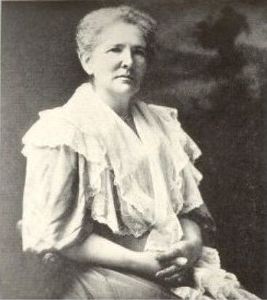
Laura Elizabeth Howe Richards was born February 27, 1850, at 74 Mount Vernon Street, Boston, Massachusetts, to distinguished parents and a home life that would early introduce her to the delights of language and fine arts as well as to a range of people and experiences. Her father, Samuel Gridley Howe, a restless social reformer who later gained fame as an abolitionist, was also the practical founder of the Perkins Institution and Massachusetts School for the Blind in 1832. Howe’s star pupil – and Laura’s namesake – was Laura Bridgman, a child who had been left blind and deaf after a bout with scarlet fever at age two. When Bridgman was seven, Howe met her and brought her to Perkins, where she became the first blind and deaf person to learn language and “finger spell.” (Another Perkins student, Anne Sullivan, later taught Helen Keller.) Richards’s mother, the poet Julia Ward Howe, is perhaps best known as the author of “Battle Hymn of the Republic.” Laura was the youngest of four children: Julia, Florence (named for her godmother, Florence Nightingale), and Henry. A fifth child, Maud, was born a few years later, and a sixth, Sam, (who died of diphtheria at age three), several years after.
Richards Laura E.
Страница автора на языке: Английский
Пол: женский
Дата рождения: 27 February 1850
Место рождения: 74 Mount Vernon Street, Boston, Massachusetts, U.S.
Дата смерти: 14 January 1943
Место смерти: 3 Dennis St. Gardiner, Maine, U.S.
Количество созданных книг: 1
Биография
Список книг

Жанры
- Фантастика и Фэнтези
- Детективы и Триллеры
- Проза
- Любовные романы
- Приключения
- Детские
- Поэзия и драматургия
- Старинная литература
- Научно-образовательная
- Компьютеры и Интернет
- Справочная литература
- Документальная литература
- Религия и духовность
- Юмор
- Дом и Семья
- Деловая литература
- Жанр не определен
- Техника
- Прочее
- Драматургия
- Фольклор
- Военное дело